From Grand Opening to Grade I Glory
The West Pier opened on 6 October 1866 as one of the finest examples of Victorian seaside architecture in Britain. Designed by Eugenius Birch, the celebrated pier architect, it stretched 1,115 feet into the English Channel and featured an ornate "oriental" style influenced by Brighton's nearby Royal Pavilion. Gas lamps with ornamental serpent designs lined the promenade, and the ironwork was manufactured by Robert Laidlaw using cast-iron threaded columns screwed directly into the seabed.
The pier quickly became a favourite among Brighton residents, distinct from the Palace Pier which attracted more day-trippers. In 1893, the pierhead was extended under the supervision of Birch's nephew, Peregrine, adding a pavilion with capacity for 1,400 people. The addition of an eight-sided grand concert hall in 1916, opened by the King's Royal Rifles silver band, cemented the pier's status as a cultural destination. By 1918, the West Pier was drawing two million visitors annually, and by 1920 ticket sales for concerts accounted for 43 per cent of its revenue.
Decline, Closure and Near Demolition
The pier's fortunes began to wane after the Second World War, when central decking was removed to prevent enemy landings. Post-war alterations saw the concert hall converted to a tea room and the theatre become a restaurant; a funfair was added in the early 1950s. By the 1960s, the pier faced serious financial difficulties. It was bought by a hotel and entertainment company in 1965, but the new owners could not meet maintenance costs, and Brighton Corporation served compulsory repair notices. The company opted for voluntary liquidation.
The pierhead closed in 1970 on safety grounds, and the entire structure shut five years later. In 1976, Brighton Council proposed demolishing the unsafe sea end, but reversed its position following a large petition organised by the "We Want the West Pier Campaign." The West Pier Trust was formed in 1978 and purchased the structure from the council in 1983 for a peppercorn fee of £100. A significant milestone followed in 1982, when the pier became the first in Britain to receive Grade I listed status; it remains the only pier in the country to hold this designation.
Storms, Fires and Collapse
The structure suffered storm damage during the Great Storm of 1987, and shore access was removed in 1991 for safety reasons. A National Lottery pledge of £14 million in 1998 offered hope, but the West Pier Trust could not find a suitable partner to proceed, and opposition from the owners of the Palace Pier, who claimed unfair competition, further complicated matters. By 2001, English Heritage had identified the West Pier as the most at-risk Grade I listed structure in the United Kingdom.
The end came in dramatic stages. On 29 December 2002, storms caused the walkway connecting the concert hall and pavilion to collapse into the sea. The following month, the concert hall itself fell, leaving part of the structure hanging at a 30-degree angle. Then, on 28 March 2003, a fire of "doubtful origin" engulfed the pavilion at the pierhead. Geoff Lockwood of the West Pier Trust told the BBC at the time: "There's nothing combustible there, there is no electricity and there is no access from the land so how it started is a puzzle." Station Commander Phil Thompson of the fire service stated that "there is no way it could have started on its own." Fire crews were forced to fight the blaze from boats, unable to access the pier from land due to the gap in the structure.
A second fire struck on 11 May 2003, consuming most of what remained of the concert hall. Fire officer Danny Sherman told the BBC: "There were several seats of fire inside the structure itself; which is very unusual. If I was a betting man, I would bet that this one has been started deliberately." The fire coincided with the Brighton Festival, and reports suggested fireworks had been let off along the seafront. The pier was reduced to a charred skeleton.
Further collapses followed: the middle of the pier fell in June 2004, and in July that year English Heritage declared it beyond repair. The structure split in half during storms in February 2014, and another section collapsed in February 2016. Most recently, the southwest corner fell overnight during Storm Claudio in November 2022.
A Living Ruin on the Seafront
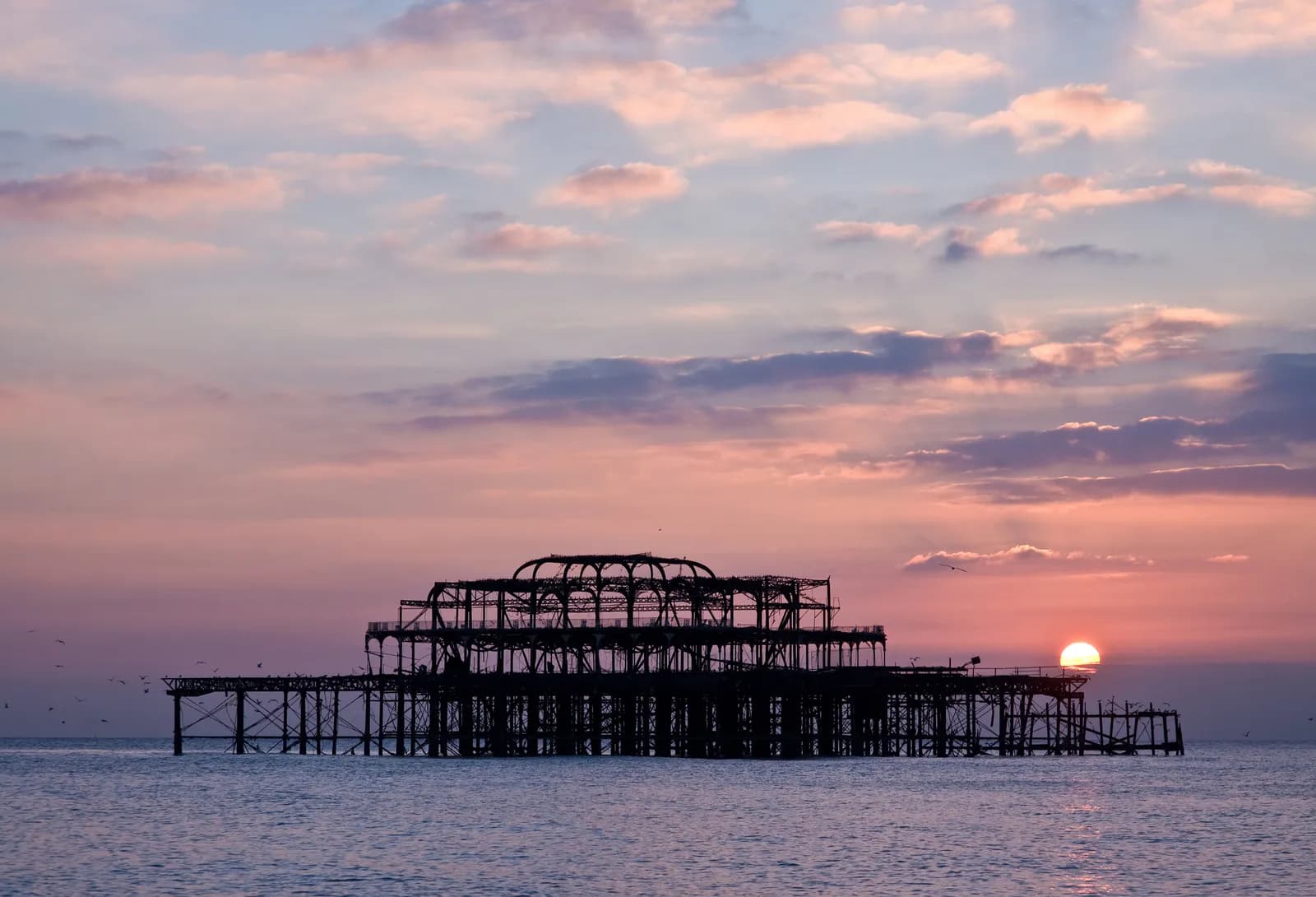
Today, only a partial metal framework remains of Birch's masterpiece. The West Pier Trust, which still owns the remains, describes the structure as an "active living ruin" and warns that it is dangerous and should not be approached. The Trust maintains a management plan to mark the site, warn the public, and remove debris at low water, but lacks funds to maintain the structure in a steady state. It predicts the pier will eventually become an off-shore reef visible only at low tide.
Yet even in decay, the West Pier remains a powerful presence. The Trust describes it as "the most photographed building in Brighton," and its skeletal silhouette continues to cast what the Trust calls an "eerie beauty" over the seafront. The ruin has become a haven for cormorants and other sea birds, and artefacts from the structure are displayed at the Brighton Fishing Museum. The West Pier Centre, open Friday to Monday, offers exhibitions and information to visitors.
The Trust has shifted its focus from restoring the original structure; by October 2016 it concluded that preservation was beyond practical means. Instead, it is now investigating the creation of a new contemporary West Pier that would complement the city's character. Whether this ambition is realised in time for the 160th anniversary in 2026 remains uncertain.
What Is Confirmed
The dates of construction, opening, extension, and closure are well documented, as are the dates of the 2002 storm collapse, the two fires in 2003, and subsequent collapses in 2004, 2014, 2016, and 2022. The Grade I listing, visitor figures, and the West Pier Trust's current management position are all verified by primary sources.
What Is Unclear
The precise causes of the 2003 fires remain officially unconfirmed. While fire officials and the West Pier Trust expressed strong suspicion of arson, no successful prosecutions have been publicly reported. The future of any new pier construction also remains speculative, with no confirmed funding or planning approvals in place.