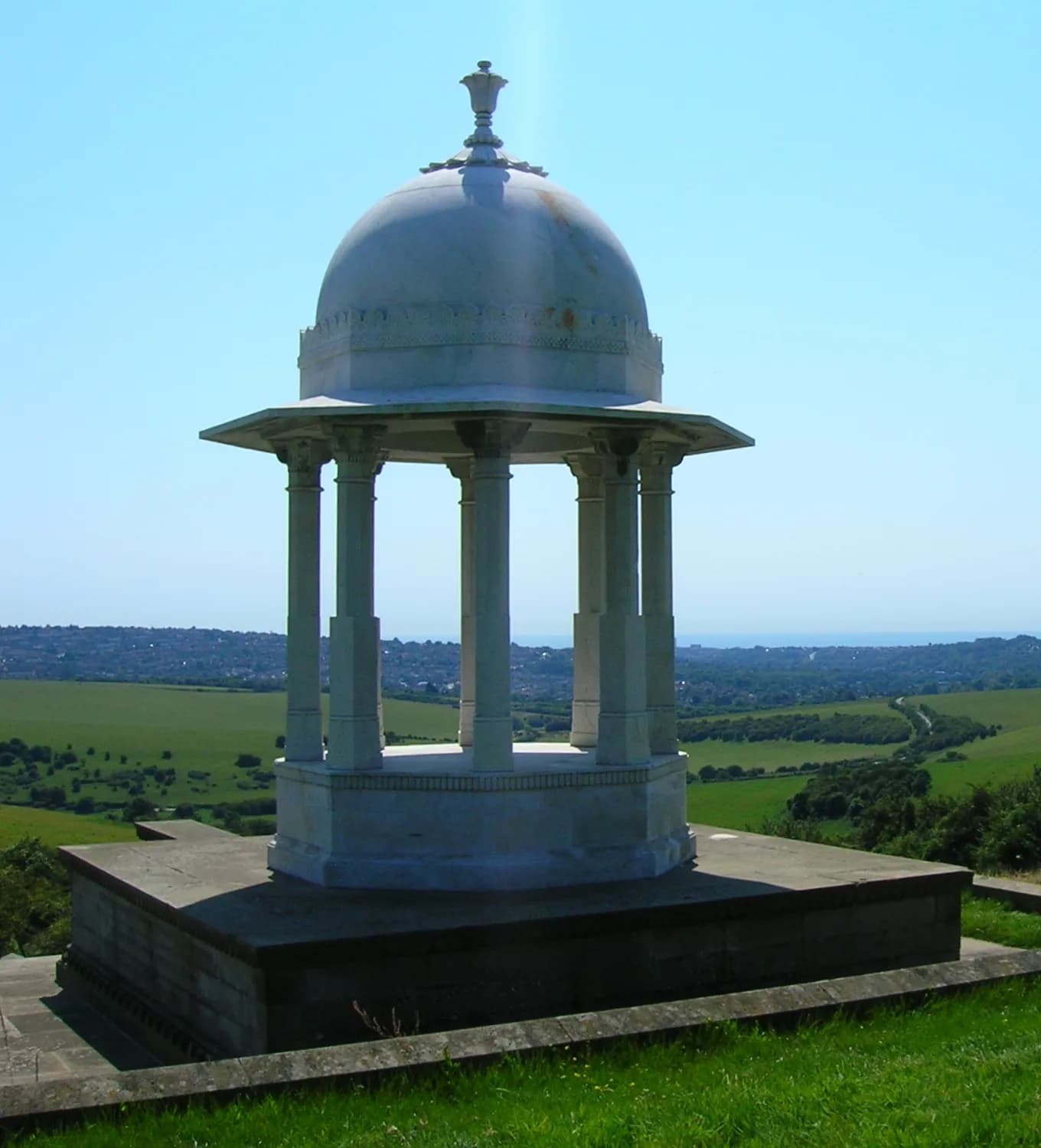
High on the South Downs above Brighton stands a white marble dome that few residents ever visit. The Chattri commemorates Indian soldiers who died in the city during the First World War, yet it remains one of the city's least-known landmarks.
A Hospital Fit for a Prince
In December 1914, 345 injured Indian soldiers arrived by train at Brighton station. The Royal Pavilion, an Indo-Saracenic palace built for George IV, had been converted into a military hospital with over 720 beds and two operating theatres. Over the following thirteen months, more than 2,300 Indian Army soldiers passed through its wards.
The hospital operated with careful attention to religious and cultural requirements. Nine separate kitchens prepared meals according to caste and religious dietary laws. Muslim soldiers were given space to pray facing Mecca, whilst Sikh soldiers had access to a tented gurdwara. The facility was visited by Lord Kitchener in July 1915 and King George V in August 1915, who presented military honours to wounded soldiers including Mir Dast.
Death on Foreign Soil
Of the 4,300 Indian soldiers treated in Brighton hospitals during the war, 74 died. The 21 Muslim soldiers were transported to the Shah Jahan Mosque cemetery in Woking, Surrey for burial. The 53 Hindu and Sikh soldiers were cremated at Patcham Down, on the South Downs north of the city. Open-air cremation was legally questionable under the Cremation Act 1902, yet the authorities permitted it to honour religious requirements.
Building the Memorial
Lieutenant Das Gupta of the Indian Medical Service approached Brighton Mayor Sir John Otter in August 1915 with a proposal for a memorial. Otter chaired the Indian Memorials Committee and became the project's driving force. The Marquess of Abergavenny donated the site and surrounding land to the borough in 1916. The India Office agreed to share the cost, with support from Sir Walter Lawrence and Secretary of State for India Austen Chamberlain.
Construction began in August 1920 and was completed by December that year. The monument cost £4,964 and was designed by architect Elias Cosmas Henriques, recommended by Sir Samuel Swinton Jacob. The structure features a white Sicilian marble dome supported by eight columns, resting on a grey stone plinth. Three granite blocks cover the original cremation slabs. The memorial stands 29 feet high with a diameter of 9 feet. An inscription in English, Hindi, Punjabi and Urdu reads: "To the memory of all Indian soldiers who gave their lives for the King-Emperor in the Great War, this monument, erected on the site of the funeral pyre where the Hindus and Sikhs who died in hospital at Brighton passed through the fire, is in grateful admiration and brotherly affection dedicated."
Unveiling and Early Ceremonies
Edward, Prince of Wales unveiled the memorial on 1 February 1921. The ceremony included a 21-gun salute. The Prince told attendees that "our Indian comrades came when our need was highest, free men and voluntary soldiers who were true to their salt." Sir John Otter expressed hope that the memorial would "strengthen ties between India and [the United Kingdom]."
The Royal British Legion organised a pilgrimage on 18 September 1932. An annual ceremony was held from 1951 to 1999, after which the tradition lapsed.
Revival and Present Day
After the annual ceremonies ceased, a local Sikh teacher revived the tradition. Since 2000, an annual service has been held on the third Sunday in June, supported by Hindu and Sikh community groups alongside armed forces representatives and veterans.
In September 2010, the Commonwealth War Graves Commission unveiled a separate memorial adjacent to the Chattri. The Patcham Down Indian Forces Cremation Memorial commemorates the 53 soldiers by name. Their names had originally been recorded at the Neuve-Chapelle Memorial in France and the Hollybrook Memorial in Hampshire. The new memorial bears the inscription: "IN HONOUR OF THESE SOLDIERS OF THE INDIAN ARMY WHOSE MORTAL REMAINS WERE COMMITTED TO FIRE."
Visiting the Chattri
The memorial sits at Deep Bottom, off the A27 at Patcham, 500 feet above sea level and approximately 1.25 miles north-northeast of All Saints Church. It is accessible only by bridleway from a path off the A27 Brighton Bypass. Motorists should take the A23 to the A27 towards Lewes, exit at the second small roundabout into Braypool Lane, park on the brow of the hill, and follow the sign-posted footpath. The nearest bus stop is at Patcham Place YHA on London Road, served from Old Steine.
The site is always open. On official memorial service days, vehicles are permitted to park near the monument.
The Chattri has been a Grade II listed building since August 1971. In 2017, it was designated a "Centenary Field" as part of the Fields in Trust project marking 100 years since the First World War. The surrounding downland is recognised as a Site of Nature Conservation Importance.
A Legacy of Service
Over one million Indian troops served during the First World War, with more than 60,000 deaths. The Chattri stands as a reminder of Brighton's role in treating the wounded and of the soldiers who died far from home. The word "chattri" means umbrella in Hindi, Punjabi and Urdu, offering symbolic shelter to the memories of those who passed through fire on the South Downs.